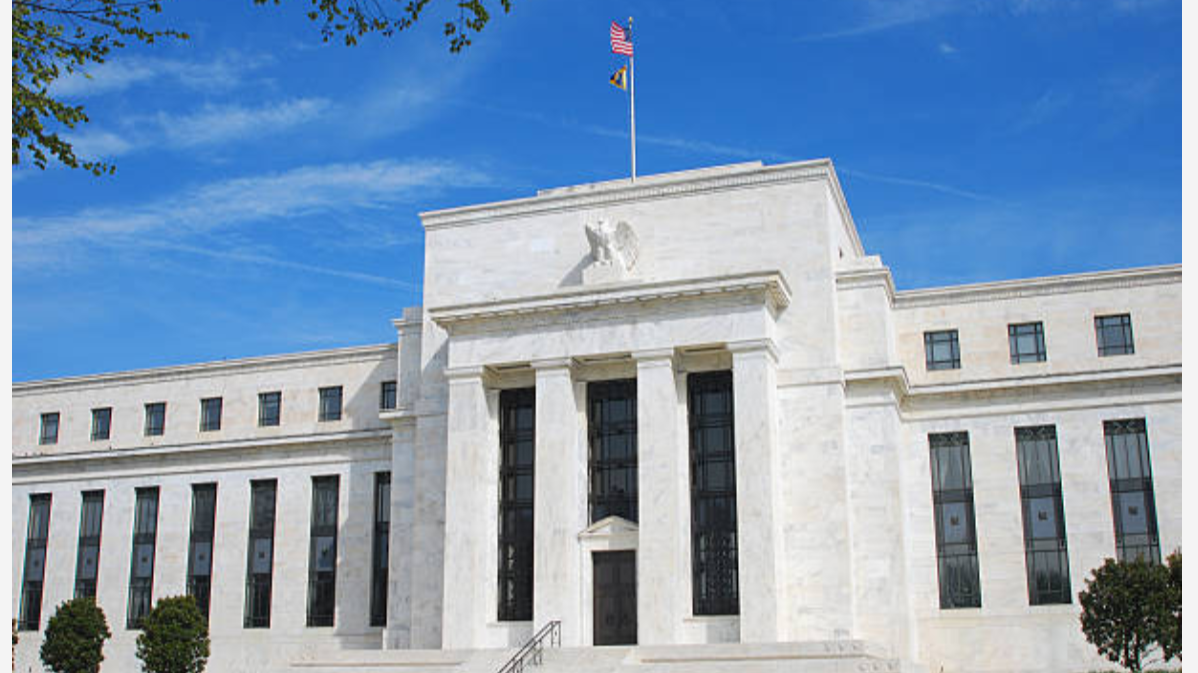
The Fed cuts interest rates
The US central bank, the Federal Reserve (Fed), is meeting next week. Almost everyone expects interest rates to be cut by 0.25 percentage points. Not because the economy clearly demands it, but because the Fed has painted itself into a corner. Backtracking is now almost impossible without losing face.
The market turned around rapidly
Two weeks ago, the market still expected no interest rate cut in December. Then, important Fed directors made statements. John Williams of the New York Fed said there was room for further adjustments. Shortly afterwards, Fed Governor Christopher Waller noted that the weaker labour market justified an interest rate cut. At the same time, retail sales were disappointing, and consumer confidence declined. Within a few days, the market swung from doubt to certainty.
US consumer confidence
The federal government shutdown in the US drove consumer confidence to a near-record low in November, falling about 6% to 50.3 points, according to the University of Michigan’s monthly index. It’s at its lowest level since June 2022 during the COVID-19 pandemic and the weakest since at least 1978. Concerns about the economic impact of the shutdown, which has lasted for more than a month, are widespread among Americans. The lack of federal financial data, such as the monthly jobs report, is forcing investors to rely on private surveys that show a slowdown in job growth and record-high layoff figures since 2003.

The stock markets reacted enthusiastically. The S&P 500 rose by about five per cent. Interest-rate-sensitive stocks performed exceptionally well: homebuilders, transport companies and chemical companies. The narrative of lower interest rates is now determining sentiment. Rationally speaking, this is strange. A 0.25 percentage-point interest rate cut makes little difference to equities. The effect on corporate profits is small. Yet the market is reacting as if it were a major event. This shows how obsessed investors are with the Fed. Expectations often have more impact than what actually happens.
Fed Chairman Powell will likely have to make concessions to secure an interest rate cut. Some directors will vote against it. Communication will become stricter: further cuts are not a given and depend on new economic figures. The bar will therefore be set higher.
The labour market is cooling down.
Recent figures from ADP show that the US labour market is cooling down significantly. In November, 32,000 jobs were lost in the private sector. That is a major setback. Wage growth fell to 4.4 per cent on an annual basis.
ADP National Employment Report
The ADP National Employment Report for the US is a monthly indicator of private-sector job growth, based on payroll data from millions of employees.

The contraction was widespread across sectors, but small businesses in particular were pulling back. According to ADP, hiring policy has been unpredictable lately. Employers are struggling with cautious consumers and an uncertain economic environment.
This weak labour market report gives the Fed an additional argument for cutting interest rates next week. At the same time, it raises questions about the health of the US economy. Is this the beginning of a broader slowdown? Or just a temporary dip? That uncertainty makes it difficult for the Fed to look far ahead.
Concerns about the new Fed chair
President Trump has said that he has narrowed his choice for the new Fed chair down to one candidate. Almost all signs point to Kevin Hassett, his loyal economic adviser. Prediction site Polymarket gives him an 80% chance.
Hassett is currently the director of the National Economic Council. He defends Trump’s import tariffs, claims that Trump’s policies have increased real wages and believes that interest rates should be lowered more quickly. As Fed chair, he is likely to place greater emphasis on employment and financial market stability. And less on the risks of inflation.
So far, the market has reacted positively to the prospect of Hassett as chairman. Investors expect interest rates to continue falling for longer under his leadership. But not everyone is reassured. Critics point to previous misjudgments. In 1999, Hassett wrote the book ‘Dow 36,000’, in which he predicted that shares would rise sharply. The opposite happened: the dot-com bubble burst. During the coronavirus pandemic, he predicted that the number of deaths would fall to zero in May 2020. That turned out to be dangerously optimistic.
The independence of the Fed
The big question is what will happen to the Fed’s independence. Trump may soon gain a majority on the board of governors, which has seven members. That would give his administration more influence over interest rate policy. Hassett’s appointment raises additional questions, especially among foreign central banks and international investors.
Some analysts warn that too rapid interest rate cuts could reignite inflation. If investors start to believe that the Fed prioritises growth over price stability, this could undermine confidence. And it is precisely that confidence that has been the basis on which the Fed has operated for decades.
Powell has defended the Fed’s credibility in recent years. He has always emphasised that decisions are based on data, not political wishes. Hassett will have to prove that he can conduct policy with discipline and independence, even though he is one of Trump’s most trusted advisers. That challenge will determine not only his own tenure as chairman, but also the Fed’s reputation in the years to come.